
Nimitz High Students Head to NASA for MATE Texas Regional ROV Contest

Nimitz High students Apricio, Víctor Rivas, Darinese Bennett and Alcmene González work on the Renegator.
The Nimitz High School robotics underwater remote operated vehicle (ROV) team is preparing to compete in the 2014 Marine Advanced Technology Education (MATE) Texas Regional ROV Contest.
At regional events around the world, teams will be vying to advance to the international contest set for June 26-28 at the Thunder Bay National Marine Sanctuary in Alpena, MI.
The regional event will be hosted at NASA’s Sonny Carter Training Facility (SCTF). The facility provides controlled neutral buoyancy lab to simulate the zero-g or weightless condition that is experienced by spacecraft and crew during space flight. It is an essential tool for the design, testing and development of the International Space Station and future NASA programs.
The contest is set for Saturday, April 26 between at 8:00 a.m. and will conclude around 4:30 p.m.
Engineers from NASA and related technology companies will be judging the teams on their technical reports, presentations and performance of their robot completing 16 tasks underwater in less than 15 minutes.
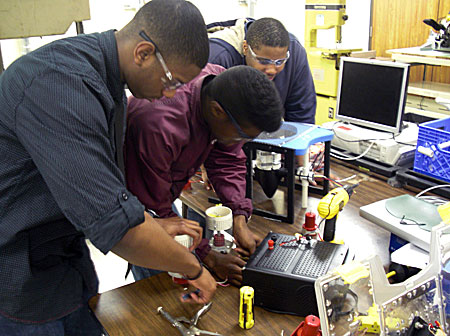
Nimitz High students Kenneth Field, Malik Randle and Jamarius Monroe are pictured working on the Renegator.
The Nimitz team’s robot is named the “Renegator.” The 20-member team has been building the robot since August 2013. According to David Ericson, robotics instructor and team captain, representatives from the United States Navy are coming to Nimitz High to view the launch and testing of the Renegator next week.
Nimitz has won these competitions in the past under the direction of retired teacher Gary Rodgers, who continues to serve as a mentor for the team. This is a new team this year and the first time Ericson has led students to the contest.
The Nimitz High students used Autodesk Inventor CAD and the school’s robotics lab in designing, manufacturing and building their robot.
“The Renegators team has built a competition-worthy underwater robot,” said Ericson.
Controlling the robot under water from the surface is in itself a complicated task. The robot is controlled from the surface using a tether that is attached to the robot via a control box. The Nimitz High team’s ROV has color cameras, multiple motors, an air-actuated claw for grabbing objects and a vacuum system for taking underwater samples. Using nothing more than underwater cameras the team will perform tasks designed to simulate searching and documenting ship wrecks.
“I am proud of the Nimitz High students who designed, manufactured and built the robot,” said Ericson.
About the Author: Leticia Fehling