Hailed as Heroes: First Responders, Davis High School’s Coach Terence Brown Reunite With Survivor
Bystander CPR can double or triple a person’s chance of survival in out-of-hospital cardiac arrests.

Scott Susor (l) met Terence Brown (r) to thank him. Coach Brown performed CPR on Susor.
[dropcap color=”#888″ type=”square”]O[/dropcap]n April 5, Scott Susor was doing what he loves: playing baseball. Scott pitched the first inning and walked back to the dugout when he suddenly collapsed.
Players gathered around him and described a seizure. Umpire Terence Brown approached the dugout just as someone said, “He is not breathing! Does anyone know CPR?”
Brown immediately went into action. He commenced to administer bystander CPR on Susor. At the same time, David Hydorn, another bystander, called 9-1-1.
 Houston Fire Department emergency medical technicians arrived a few minutes later. They took over CPR and shocked Scott with an Automated External Defibrillator (AED). Paramedics shocked Scott at least seven more times and restored his pulse.
Paramedics delivered Susor to a local hospital where he made a full recovery.
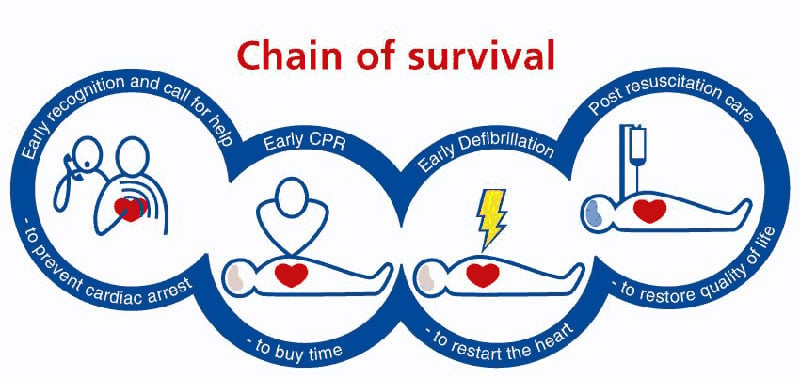
Scott and his wife Doreen recently met and thanked everyone involved in his rescue. They are grateful to everyone who formed part of the link in the Chain of Survival. Their actions increased his chances of survival and recovery.
Among those at the reunion was Coach Terence Brown. He is a teacher and coach at Aldine ISD’s Davis High School. On his off time, Brown works as an umpire in little league and adult baseball leagues. Brown said he always wondered if he would be able to perform CPR if the need arose.
“The school district requires all coaches to undergo CPR training,” said Brown. “I just never knew if I would be able to do it.”
Brown has undergone CPR training for more than 18 years. He never had to use the knowledge and skill until that fateful day with Susor.
The Houston Fire Department set up the survivor reunion in May. This was a little more than a month since the Susor suffered cardiac arrest. According to Diana Rodríguez, these reunions are important to everyone involved. Rodríguez is spokesperson for the Houston Fire Department.
“The EMTs and firefighters usually don’t know what happens after they drop the patient at the hospital,” said Rodríguez. “The survivor reunion gives everyone involved a chance to know the results of their rescue efforts. The reunion is emotional. It has a powerful impact on first responders. It also reinforces the importance of CPR and AED training as well as the links in the Chain of Survival.”
 When Scott Susor walked into the firehouse for the reunion, Brown did not recognize him.
“He looked so different,” said Brown. “Younger in fact.”
Scott did not recognize Brown either. He indicated he did not remember Brown. He has no memory about anything in the five to 10 minutes before the incident.
Scott’s wife was the first person to recognize Brown. She hugged him and thanked him for saving her husband’s life. In classic Coach Brown fashion, he acted as if it was nothing. It was just part of the job.
Scott’s wife pointed out Brown to her husband. At seeing Brown, he exclaimed, “There he is!”
The two men embraced. Both grateful for the miracle of survival.
Cardiac arrest is a leading cause of death in the country. Each year, about 326,000 people have an emergency medical services-assessed cardiac arrest. This figure is just for cardiac arrests that occur outside the hospital. Bystander CPR can double or triple a person’s chance of survival. Yet fewer than half receive it, according to the American Heart Association. Almost 90 percent of people who suffer out-of-hospital cardiac arrests die.
Most bystanders feel hesitant to act during a cardiac emergency. Either they don’t know how to administer CPR or they’re afraid of hurting the victim.
When a person suffers a cardiac arrest, those first few minutes are vital. Survival depends on immediately getting CPR from someone nearby. It can increase a person’s chance of survival.
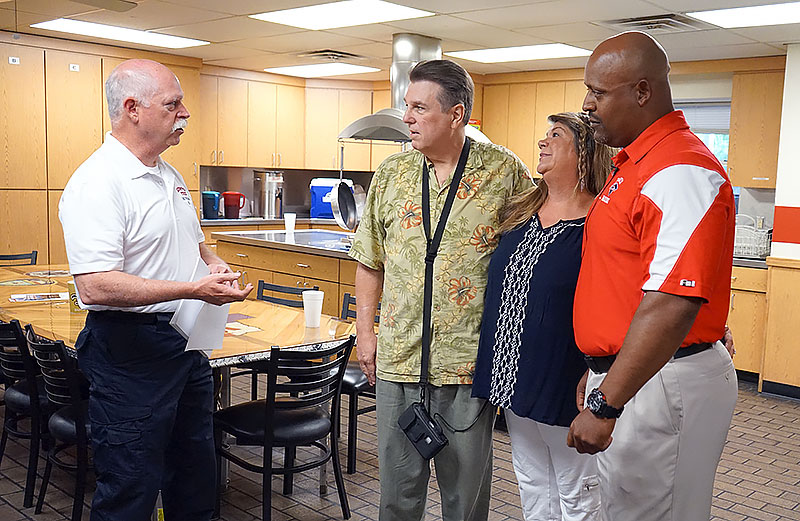
Scott, his wife Doreen and Coach Brown at the HFD.
Brown hopes his experience as a first responder inspires others in the community to get CPR training.
“You never know when you’ll have an opportunity to help save a life,” said Brown. “I know I didn’t. Honestly, I am happy that I was able to help and make a difference.”
About the Author: Leticia Fehling