Kujawa EC/PK Center’s Maggie Abrego Wins Marian and Speros Martel Early Childhood Education Award
The Children’s Museum of Houston recognized the teacher who harnesses students’ curiosity.

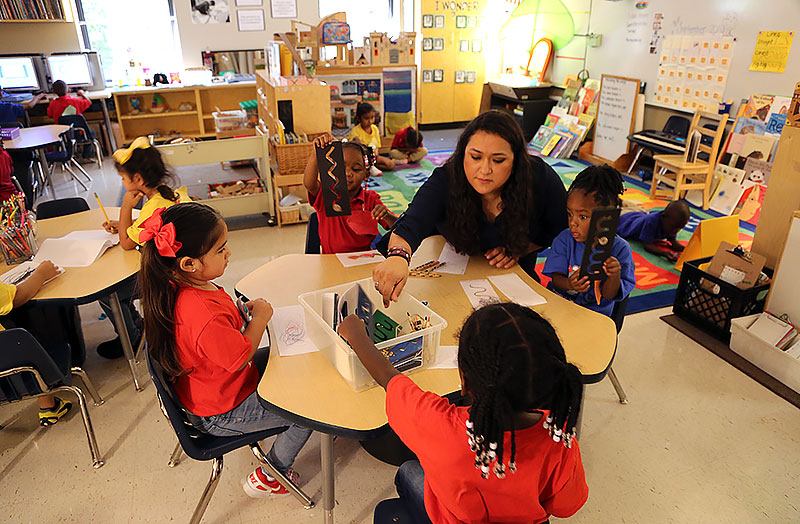
Maggie Abrego (far left) works with students in her Reggio Emilia-inspired classroom.
[dropcap color=”#888″ type=”square”]M[/dropcap]aggie Abrego’s class is bustling with activity. At one table, students are working on the latest task. At another station, a group is reading and retelling a story to their classmates with puppets.
The chitter-chatter of young children fills the air. There is constant movement as they move from one station to another. There is social interaction between the teacher, the aide and students.
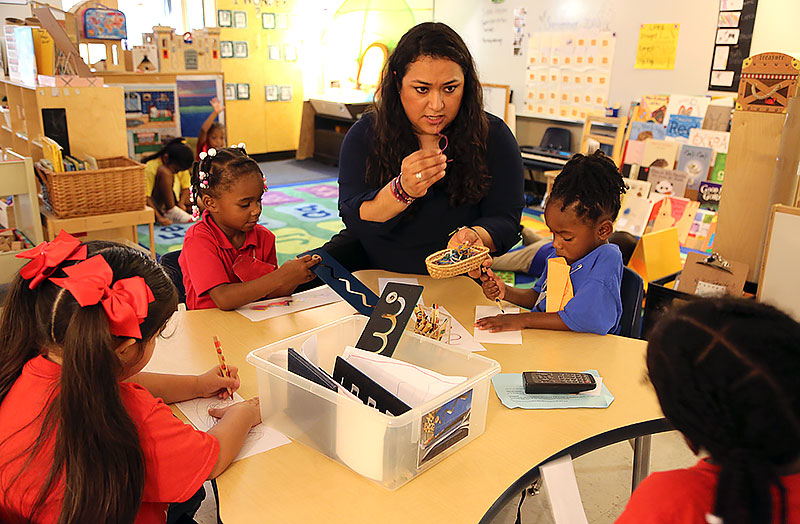 This is a relationship-driven learning environment. Maggie harnesses her students’ natural curiosity and creativity. She encourages them to work on projects that interest them. Her Reggio Emilia-inspired approach also encourages children to communicate their newfound knowledge and understanding.
The teacher, parent and child are collaborators in the learning process.
The early childhood teacher at Kujawa Early Childhood/Prekindergarten Center found inspiration from the Old World. The Reggio Emilia approach developed in Italy in the 1940s in the city with the same name. It is an innovative learning philosophy that is turning heads with its take on teaching. The approach makes parents, teachers and children equal shareholders in the learning initiative.
Reggio Emilia shares some of the values of the Waldorf and Montessori schools. Yet, it’s not a philosophy with a set system of beliefs. The importance of community and free inquiry are primary values.
It’s an approach based around certain fundamental values about how children learn.
The philosophy is student-centered. Educators see children as full of potential and wonder. They are competent and capable of building their own theories. 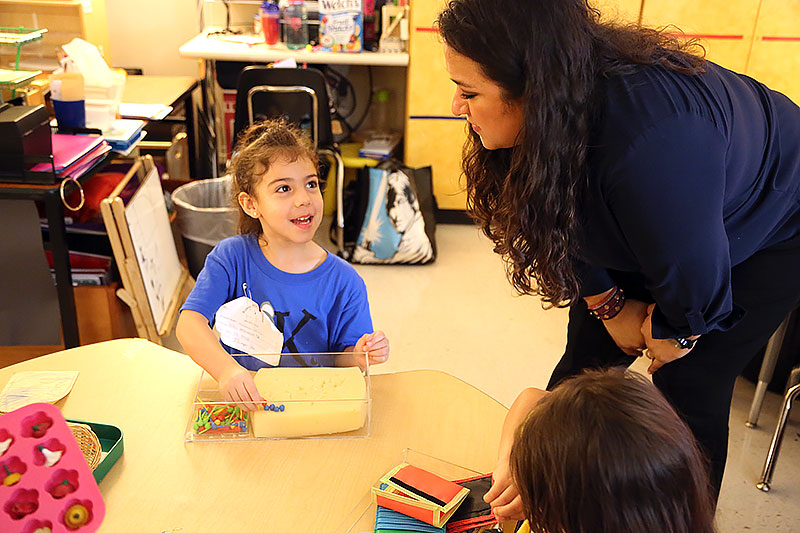
“The Reggio Emilia approach believes that all children have an innate curiosity,” said Maggie. “This drives their interest to question and understand their world. All children have potential to learn and grow.”
Not every school uses the Reggio Emilia approach. Those that do tend to use an adaptation. Educators adapt based on the needs and interests within each community. That means every Reggio Emilia school will be different.
Fundamentals of the Reggio Emilia Approach
 [ul class=”list list-search”] [li]The child as protagonist, collaborator and communicator[/li] [li]The teacher as partner, nurturer, guide and researcher [/li][/ul][ul class=”list list-search”] [li]Cooperation as the foundation of the educational system[/li] [li]The environment as the “third teacher” [/li][/ul][ul class=”list list-search”] [li]The parent as partner[/li] [li]Documentation as communication [/li][/ul]
 Typically, preschools and early childhood settings use the Reggio Emilia approach. Maggie uses her inspired approach in the classroom.
Maggie’s room is dimly lit opting for table lamps and the natural light from the windows. Stations provide hands-on learning experiences. There is a kitchen, a science area, a building area and much more. Maggie prefers natural materials and toys to plastic ones. Materials are everywhere and organized. They are within reach of the children. The Reggio Emilia approach sees the environment as a teacher. And students have lots of movement to explore and learn.
Her inspiration has a strong basis in literature. Her room is full of books. She uses literature to develop and inspire her lesson plans. Maggie works to develop her students’ understanding of narrative form. She uses [icons icon_name=”icon-external-link” icon_size=”14px”]storytelling and story acting. This includes students’ dictation and dramatization of their own stories. The strategies help young children extend their language skills, vocabularies and cultivate oral expression. These are critical factors for children learning to read and write.
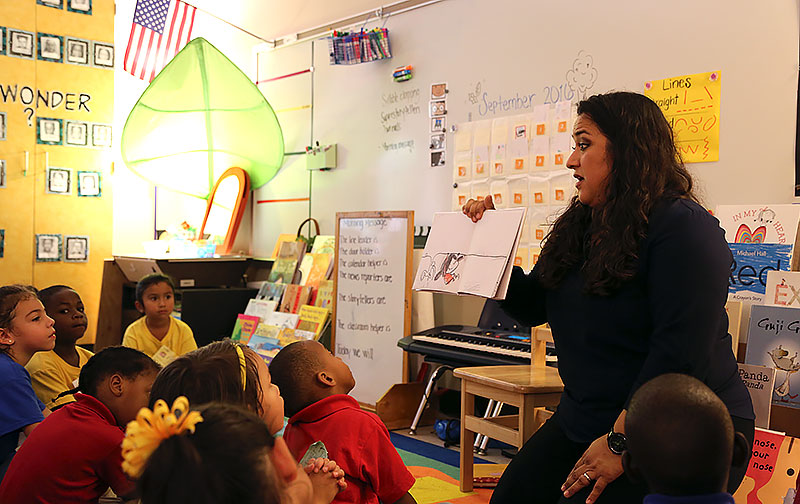
[vimeo url=”https://vimeo.com/183672994″ width=”560″ height=”315″]The day I visited, Maggie was sharing the book titled The Line by Paula Bossio with her students. It was a perfect book to learn about all types of lines like straight, wavy and angled.
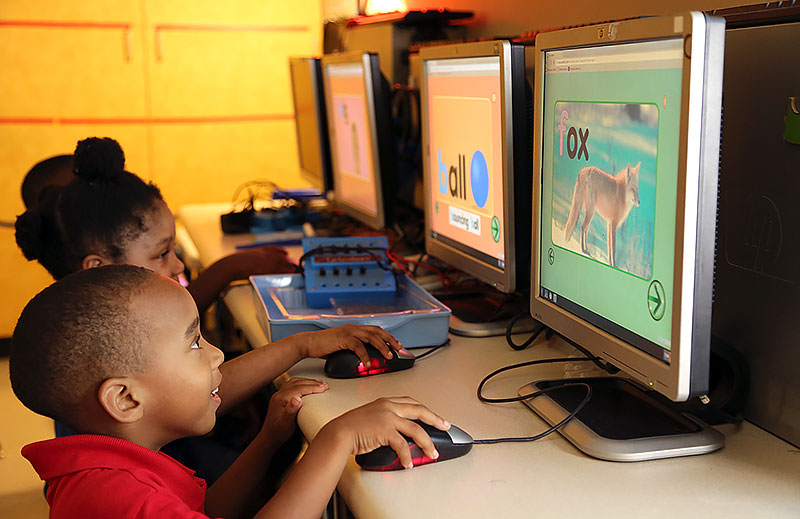
Afterwards, Maggie’s students selected the activity they wanted to do at the different stations. A group of students worked at the computer stations. Another poked holes in paper to make patterns of straight lines, wavy lines and angled lines. The students talked and used the words they had learned. And they related their activities to things at home.
Children are capable of constructing their own learning.
 Reggio Emilia educators have a deep respect for learners. Another belief of the Reggio Emilia approach is to listen and discover students’ interests. Teachers use this knowledge to plan curriculum, provide the tools and environment. At the same time, teachers are pursuing developmental improvement.
Listening also leads to implementing children’s ideas for projects on which to work.
“I believe that children have something to teach us, ” said Maggie. “One day during a lesson, a student asked what a shadow was. I incorporated it into the lessons. All the children enjoyed studying shadows. It is important to value children‘s questions. For me, learning is a collaboration. We co-explore and learn together. My role is to provide experiences that provoke children’s thinking and learning.
“Children are capable of learning when the topic is of interest to them.”
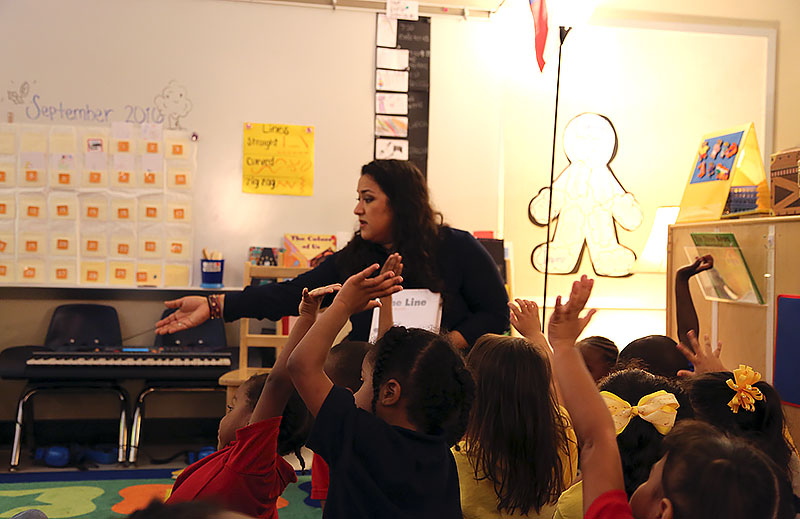 The same day of the visit, a young student followed Maggie. After finishing the work at his station, he asked question after question. Maggie addressed each question with patience. She often encouraged the young boy to discover the answer on his own and to come back to let her know when he had it. He soon did and was right behind her to share what he discovered. The answers weren’t always perfect, but the four-year-old showed enthusiasm. Maggie praised him and he was visibly proud. He eagerly moved to the next station to play, discover, learn and share. The boy was not the only one engaged. Students at each station talked to each other. They were learning and making connections all while playing.
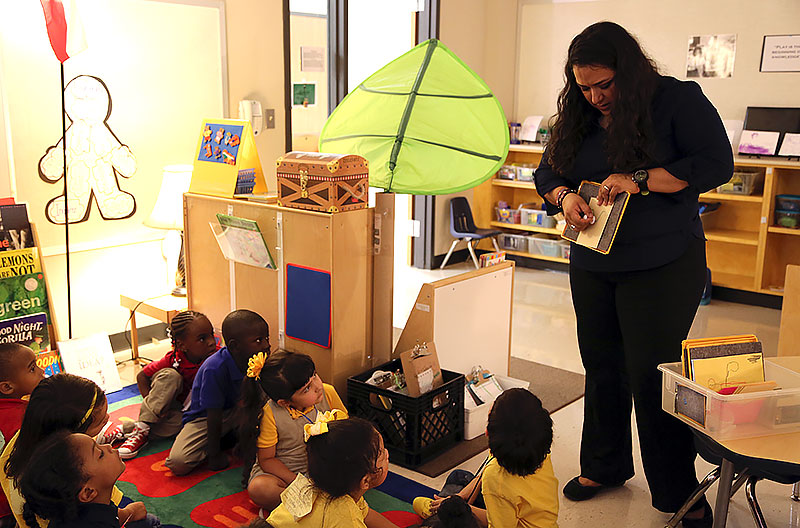 The approach encourages students to see, think and wonder. Through independent exploration, reflection and group collaboration, students make connections. Maggie challenges her students to take ownership of their learning.
Reggio Emilia is capturing international interest among early childhood schools. The popularity of Reggio Emilia has to do with its connection to the science of brain development.
Children learn by doing. They are active participants in planning and learning. Children are the best teachers themselves. The young brain is hard-wired to learn.
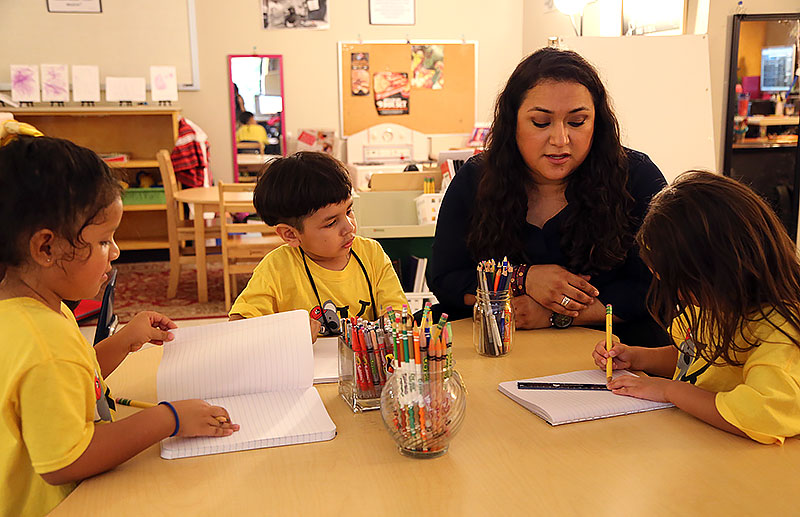 Harvard University has been researching and studying the Reggio Emilia approach. [icons icon_name=”icon-external-link” icon_size=”14px”]Harvard Graduate School of Education’s ‘Project Zero’ works to develop Reggio Emilia-inspired schools. The guiding principle is that children are the main actors in their schoolwork. With the help of their teachers, students drive decision-making about the curriculum. It is not focused on individual performance and achievement. It’s about creating a learning community essential to promoting student learning.
What does learning look like?
Children communicate their knowledge and understanding in variety of media. Much of this has creative results. Educators in the Reggio Emilia approach observe the thinking and learning process. They document student progress. Educators have outcomes but are open to different ways to show those outcomes. Intelligence is learnable and multiple. For example, a student might find strength in art while another enjoys building things.
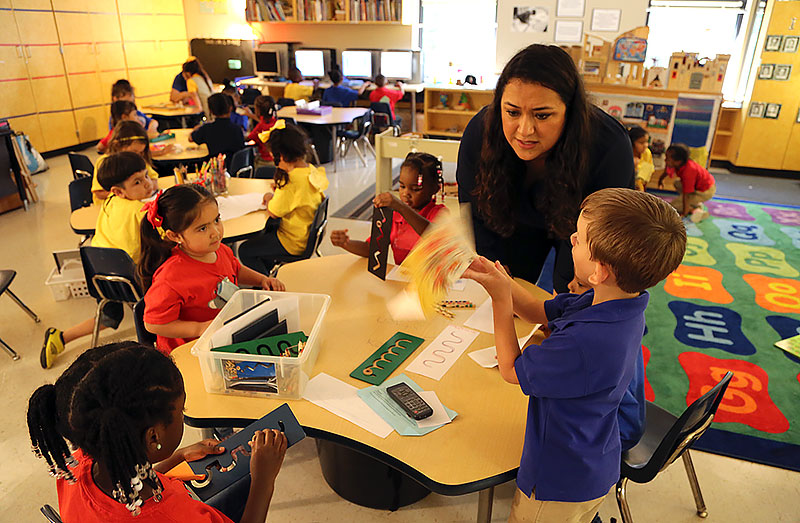 Teachers look at The Hundred Languages of Children. This is the most well known aspect of the Reggio Emilia approach. It is the belief that children use many different ways to show their understanding. And they use many different ways to express their thoughts and creativity.
“It is the belief that there is a 100 different ways of thinking,” said Maggie. “There are 100 different ways of discovering and learning.
“The Hundred Languages of Children includes art, dance, music and pretend play. I value and nurture each one of the Hundred Languages.
“These languages, or ways of learning, are all a part of the child. Learning and play are not separated. The Reggio Emilia approach emphasizes hands–on discovery learning. This allows the child to use all their senses and all their languages to learn.”
Documentation is the process that makes the work of educators visible.
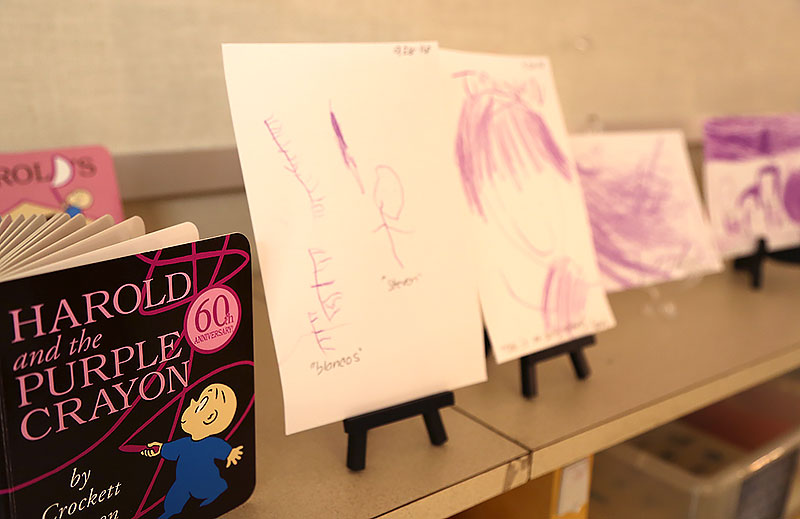 Walking in Maggie’s class there is documentation of student learning everywhere on the walls. There are pictures on display of students engaged in their work. There is also artwork and other artifacts. On one counter, students drew and wrote about Harold and the Purple Crayon. The young students’ writing is not clear. It looks like scribbles. But this early writing is facilitating the development of literacy. They develop an understanding of print, letters and the purpose of conveying a message.
Documentation is a process that makes dialogue possible. The educator can interpret, discuss and provide intervention or focus. Teachers also get to reflect about their own teaching and how children best learn. In short, it makes the work of educators visible.
“The documentation of student progress lets me see where students are at,” said Maggie. “Then I build on it to increase knowledge and skills. For example, I will see who has strong straight-line skills. And I’ll see who needs more practice. Or I see their ideas about a topic. As an educator, it is interesting to follow and see students‘ insight. I love to see them use their imagination as they learn an idea or object.
I also get to see their development in purposeful or good play such as building.
“Children express their knowledge through the projects they create. These projects tell me what the children have learned. And the students are so proud of their works.
“The Reggio Emilia approach allows children to form an understanding of themselves through their social interactions with others.”
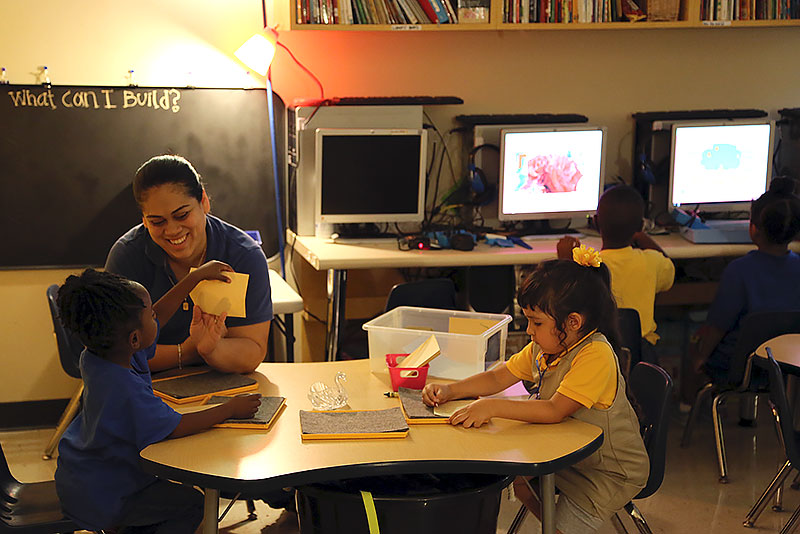
The classroom teacher’s aide works with students.
Building a Community
Parent are active partners in children’s learning. Maggie builds parent relationships. After completing each unit of study, she invites parents to visit the classroom. They can view the gallery that showcases students’ works relating to the unit. This gives students a chance to talk about their displays to their parents. The parent-student-teacher interactions strengthen and build a sense of community.
Closing the language and literacy skill gap is important to Maggie. She encourages her students to check out books. She also encourages parents to visit the school library to check out books to take home. Reading and discussing books encourages oral language development. Parents play a major role in reinforcing the skills learned at school.
The Children’s Museum of Houston recognizes Maggie with an award.
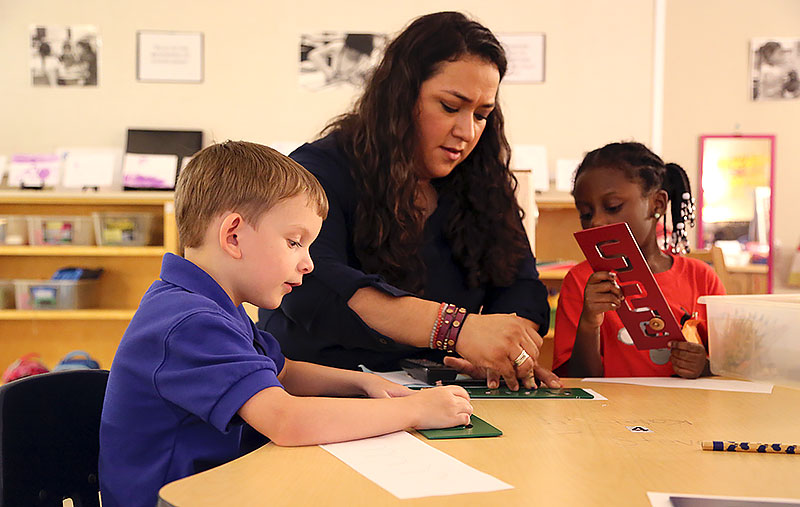 For her exemplary commitment to educating young children, Maggie received an honor. The Children’s Museum of Houston awarded Maggie with the 2016 Marian and Speros Martel Early Childhood Educator Award. Maggie received a $1,000 prize and a one-year membership to the Children’s Museum.
Kujawa Early Childhood/Prekindergarten Center is an IB® World School. The campus offers the IB Primary Years Program. It was here that Maggie began using the Reggio Emilia approach. Campus leaders encouraged educators to use the approach. Maggie researched. She then began trying new ideas as she adapted the approach for her students.
“It was hard to leave my ‘old‘ practices behind like basing lessons on my own criteria,” said Maggie. “But I found myself embracing the approach. I realized that children learn best when the lessons interest them. I witness this every day in class. Students love lessons that are relevant to them. They make connections. I also realized that I was beginning to really listen to my students. I listen to their stories, their needs, their questions and discoveries. I get to see how they think. And what I need to provide as their guide.
“I love being a part of a revolution in educational philosophy. The Reggio Emilia approach supports the creative, expressive and problem–solving potential of children.”
The 11-year veteran educator is busy speaking about her inspired Reggio Emilia approach. Maggie spoke at the Bill Martin Jr. Symposium in 2015 at Texas A&M-Commerce. The university invited her again to speak at the 2016 symposium. Maggie recently presented at the 2016 Texas Association for the Education of Young Children.
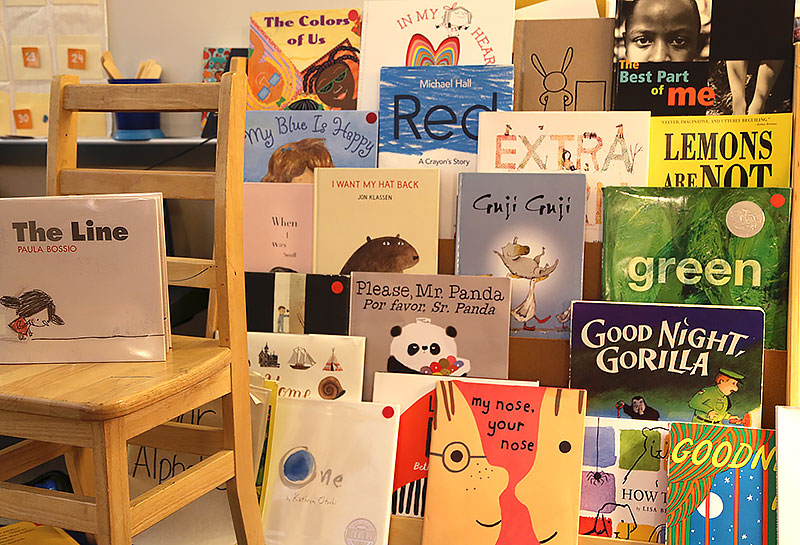 She is set to present on Oct. 1 at Rice University’s School of Literacy and Culture (SLC). The professional development session is titled “The Critical Importance of Play.” And in November, she will present on the Reggio environment at the University of Houston.
During the school year, Maggie is part of [icons icon_name=”icon-external-link” icon_size=”14px”]Rice University’s School of Literacy and Culture Writing and the Arts Program. Over the last five years, Maggie has taught in SLC and Writers In the Schools’ [icons icon_name=”icon-external-link” icon_size=”14px”]Creative Writing Summer Camp. The camp targets students in kindergarten through 12th grade.
Maggie was a resident teacher in Rice University’s Early Literacy Leadership Academy (ELLA). She graduated and received her Certification in Early Leadership and Literacy. She has spoken at several ELLA conferences and staff developments about early literacy practices.
According to Maggie, SLC and ELLA emphasized embracing the Reggio Emilia approach. They provided her with the tools she needed to understand and use the approach. Maggie also lauded her mentors and professional development she received.
“The Martel Award is a huge honor,” said Maggie. “This is an honor I share with my school principal Deborah Hagood and Aldine ISD. The school district provides a lot of professional development. And Ms. Hagood has invested so much in me. She found the resources to pay for the professional development at Rice University. It is really amazing the support I have had from the principal and the district.
“I see myself as the guide in my students‘ learning. They use all their senses and imagination to explore, learn and make connections. My students are learning through the power of play.”
In future, Maggie hopes to visit Reggio Emilia in Italy. She is applying for grants to pay for the trip. Maggie wants to learn from the educators, students and parents in the schools of the region. If she makes the trip, she would like to share what she learns with campus staff. Maggie encourages early education teachers to consider developing their own Reggio Emilia-inspired classrooms.
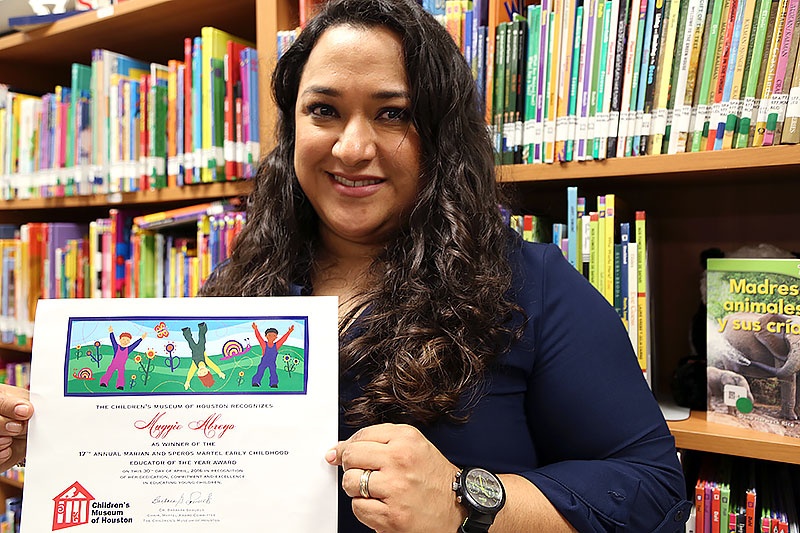
Maggie holds the Marian and Speros Martel Early Childhood Educator Award. The Children’s Museum of Houston presented Maggie with the honor for her exemplary commitment to educating young children.
Kujawa EC/PK Center is an [icons icon_name=”icon-external-link” icon_size=”14px”]International Baccalaureate (IB) World School. The campus offers the IB® Primary Years Program. Magnet Schools of America named the Kujawa Education Center a [icons icon_name=”icon-external-link” icon_size=”14px”]2016 School of Distinction.
Educators can apply for the Marian and Speros Martel Early Childhood Educator Award. The deadline to apply is December 5, 2016. Visit the [icons icon_name=”icon-external-link” icon_size=”14px”]Children’s Museum of Houston website for more information.
About the Author: Leticia Fehling