Hoffman Middle School Takes Part in Hour of Code
Important job skill of the future: Coding is becoming the most in-demand skill across industries.

Bill Robertson (kneeling) with Baker Hughes helps a student taking part in Hour of Code.
[dropcap color=”#888″ type=”square”]T[/dropcap]ens of thousands of educators around the world did an Hour of Code last week with their classrooms. Hoffman Middle School and other campuses across Aldine ISD took part.
Dwanna Callaway encouraged math teachers to have students take part in Hour of Code Dec. 5-9. Callaway is the information literacy specialist at the campus library.
Code.org is a non-profit organization created to promote diversity in the computer science industry. [icons icon_name=”icon-external-link” icon_size=”14px”]Code.org not only provides “Hour of Code” where students are able to be introduced to coding through games such as Minecraft and Star Wars, but also online courses and teacher training.
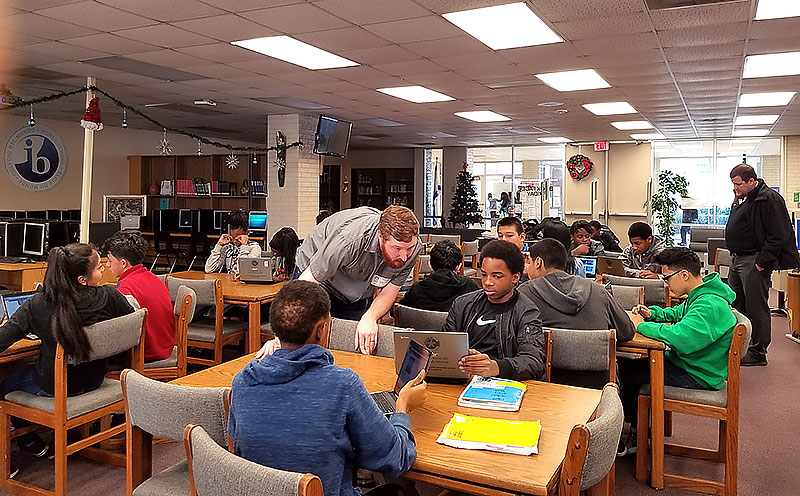
Tandy Lofland with Opportune works with Hoffman Middle School students during Hour of Code.
Guest speakers at Hoffman Middle School included Tandy Lofland with Opportune, Bill Robertson with Baker Hughes and Nicole Welch from Microsoft.
Lofland is an oil and gas industry consultant. He also describes himself as “white hat” hacker. Don’t worry. This is actually a good thing. The term refers to an ethical computer hacker. The computer security expert ensures the security of an organization’s information systems. Lofland shared with students his background in technology. There were some things he couldn’t tell the students much about. Such as the specific type of work he did at the Department of Defense.
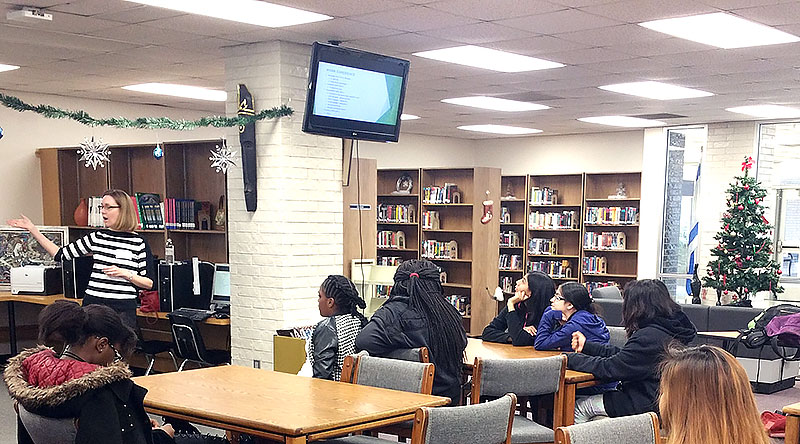
Nicole Welch with Microsoft talks to students about computer science careers during Hour of Code.
Welch is a cloud support engineer. She discussed her role in her company. Welch also shared information about computer science related careers.
Robertson is a senior technology manager. He talked to students about technology careers. And shared his experiences in his field.
All three speakers also helped students out with their Hour of Code projects.
“I am grateful to Nicole, Tandy and Bill for taking the time to speak and work with our students,” said Callaway. “As experts in their fields they helped students better understand computer science related careers. Coding has become a ‘hot’ skill to have. All three really got that point across to students and opened their eyes to a world of possibilities.”
Why is coding important?
So what is coding? Well, it is more than using established applications. Coders are able to write instructions to a computer. And it is a skill employers are seeking.
Companies in the technology sector aren’t the only ones interested in code. There are an increasing number of businesses relying on this computer skill. Software engineers can work at Apple, a hospital or at an automotive manufacturer.
A new report from Burning Glass found that there were as many as 7 million job openings in 2015 in occupations that required coding skills. The job market analytics firm also found something else. Programming jobs are growing 12 percent faster than the market average.
Who is Coding?
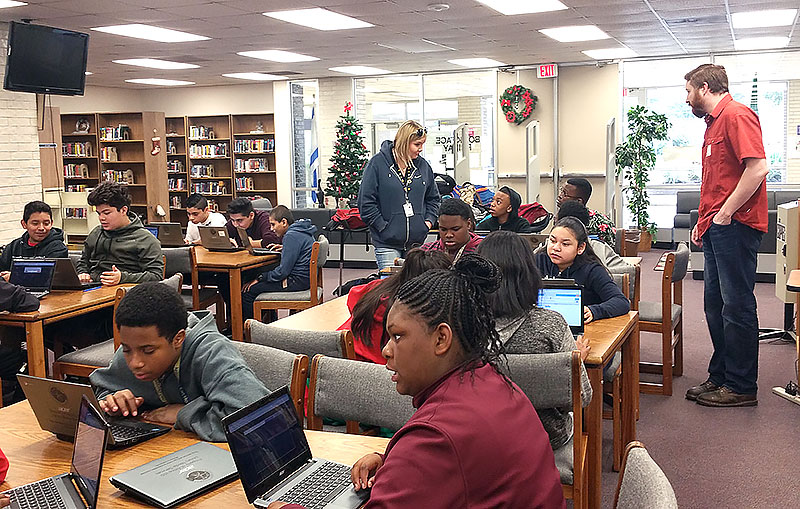
Tandy Lofland (standing, far right) with Opportune looks on as students take part in Hour of Code. Loftland is an energy consultant and “white hat” hacker.
[ul class=”list list-search”] [li]Information Technology (IT) workers[/li] [li]Data Analysts [/li][/ul][ul class=”list list-search”] [li]Artists & Designers[/li] [li]Engineers [/li][/ul][ul class=”list list-search”] [li]Scientists[/li][/ul]
Half of all programming openings are in industries outside of technology. They include finance, manufacturing and health care.
Coding has become a core skill. It can bolster a candidate’s chances of commanding a high salary. Burning Glass researchers found that jobs that require coding skills pay on average up to $22,000 per year more. Almost half of all jobs that pay more than $58,000 demand some coding skills, according to the report.
Programming languages include:
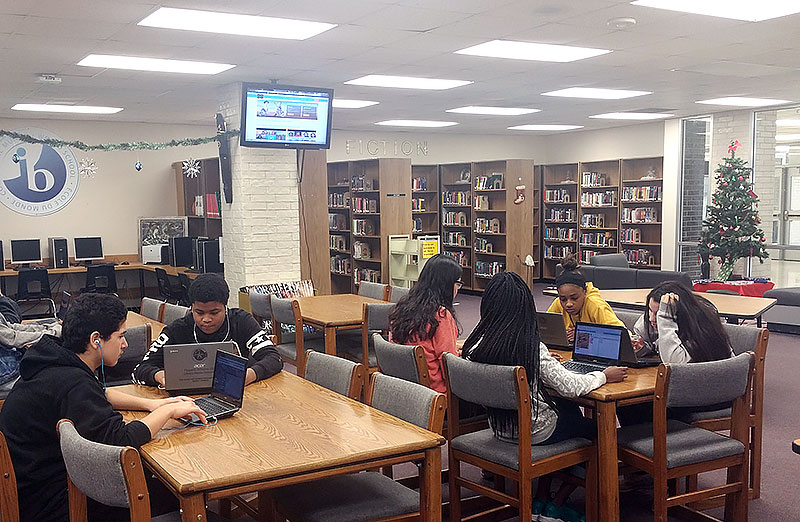
Hoffman MS students work on their Hour of Code activities.
[ul class=”list list-search”] [li]JavaScript and HTML for building websites[/li] [li]Statistical programs R and SAS [/li][/ul][ul class=”list list-search”] [li]AutoCAD programs for engineers[/li] [li]Java, Python, XML, C#, .NET and C++ for general purpose programming; C++ for engineers [/li][/ul][ul class=”list list-search”] [li]SQL – Databases[/li] [li]Javascript -Web development [/li][/ul][ul class=”list list-search”] [li]Linux – Computer system operations[/li][/ul]
Some positions in IT require more specialization. Yet, programmers don’t need a computer science degree to succeed. About 90 percent of coding jobs need a college degree, as compared to 44 percent of all career-track jobs.
What if you don’t have a bachelor’s degree or coding certification? Individuals with short-term credentials can find work. For example, they can take a role in computer user support. Other possibilities include engineering technicians and drafters. According to researchers, all these are options with considerable demand.
It is no surprise that higher institutions are watching the trend and demand for coding. MIT launched a pilot program targeting New Hampshire teachers. The program seeks to teach code and bring computer science into the curriculum. Code boot camps are also popping up everywhere including public schools.
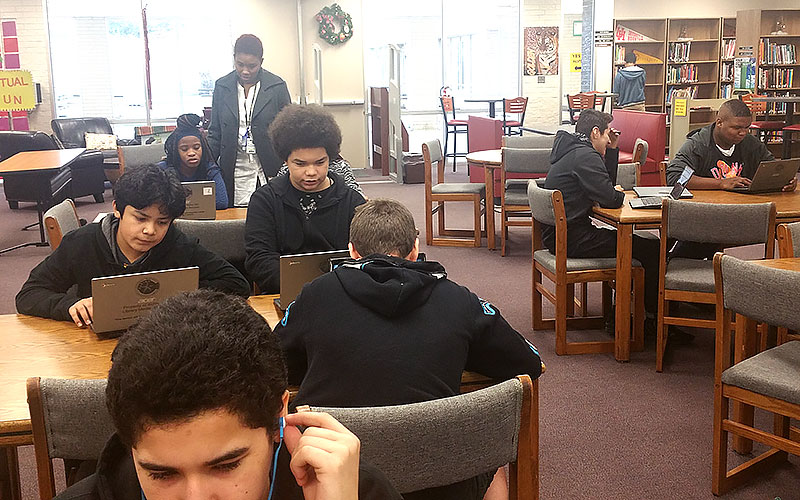
Hoffman MS students take part in Hour of Code.
Hour of Code ended. Why not keep going?
Educators don’t need any experience to start teaching computer science. Code.org offers curriculum, lesson plans, high quality professional learning programs, and tons of great tools for all grade levels—everything educators need, all at no cost.
Hoffman Middle School students interested in learning how to code have a place at the campus. The library’s MakerSpace is offering Code.org activities. Students should check with their campus library for opportunities to code.
Keep on Coding!
About the Author: Leticia Fehling