Disponible en:
 Español
May is Asian American and Pacific Islander Heritage Month
Disponible en:
Español
Today, Asian Americans and Pacific Islanders are the fastest-growing racial group in the United States. AAPI Heritage Month celebrates the unique journey of all AAPI immigrants and citizens in the United States and their unique life experiences, traditions, and cultures.
Asian Americans and Pacific Islanders have contributed significantly to American culture and society, including science and medicine, literature and art, history, culture, film and recreation, education, finance, international trade, government and politics, and activism and law.
Asian American Pacific Islander (AAPI) Heritage Month occurs every May in the United States. As of 2019, there were about 24 million of Asian or Pacific Islander descent in the United States. When many think of AAPI communities, they think of people from or that have descended from South Asia, East Asia, South East Asia, and the Pacific Islands. However, AAPI also includes West and Southwest Asia (commonly referred to as the Middle East in the U.S.). According to the Pew Research Center, AAPI people are a diverse and growing population that makes up about 7% of the total U.S. population.
The AAPI umbrella term includes cultures from the entire Asian continent, including the Pacific islands of Melanesia (New Guinea, New Caledonia, Vanuatu, Fiji, and the Solomon Islands), Micronesia (Marianas, Guam, Wake Island, Palau, Marshall Islands, Kiribati, Nauru, and the Federated States of Micronesia) and Polynesia (New Zealand, Hawaiian Islands, Rotuma, Midway Islands, Samoa, American Samoa, Tonga, Tuvalu, Cook Islands, French Polynesia, and Easter Island).
District Administrative Activities
 District leaders will be celebrating AAPI’s rich cultures and traditions. A special event will be held at the Donaldson Administration Building (DAB) and the Bamberg Professional Development and Resource Center (BAM).
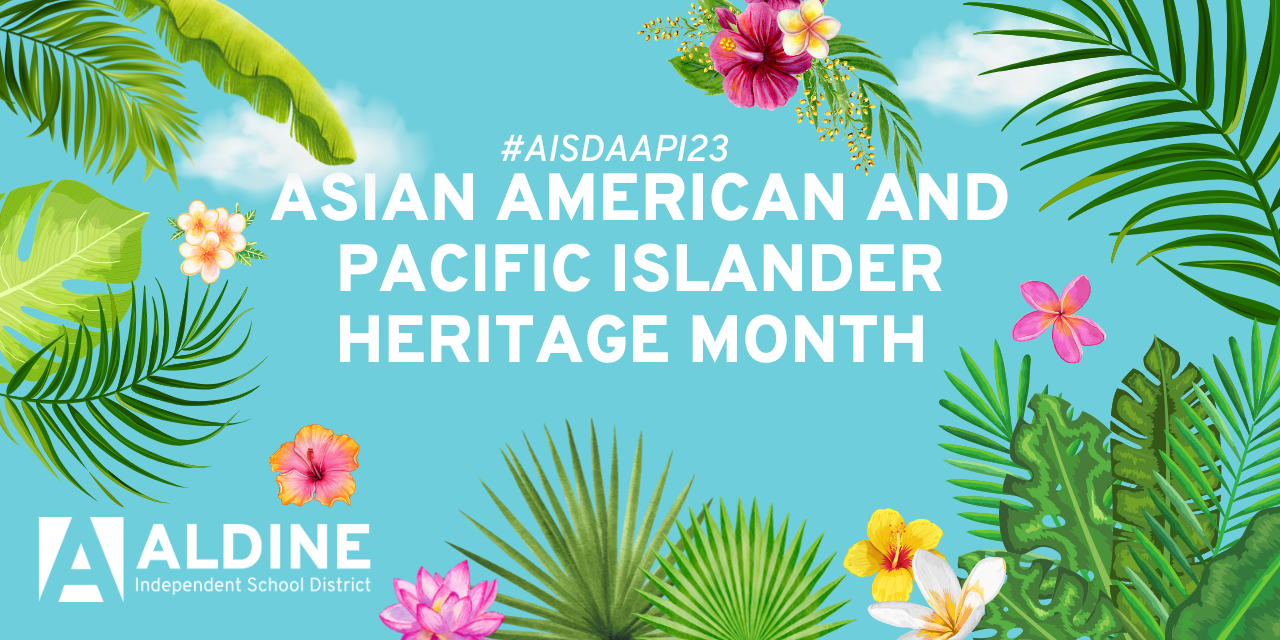
Be sure to share how you are celebrating AAPI Month on social media. Include the hashtags #AISDAAPI23,#AldineConnected, or #AldineConnectado.
MAY 1-5: HISTORY AND LITERATURE
Works of literature are great examples of people’s culture. In honor of Asian American Pacific Islander Month, commit to reading books about or written by Asian American or Pacific Islanders. Click each link below for information, titles, and a literacy activity:
History
Must Read Books
Novels
Haiku
MAY 8-12: ART, HISTORY, AND FASHION
Culture is the customs of people who live together. Aldine ISD art students will be creating cultural art walls representative of members of the Asian American community in areas of literature and fine arts.
Cultural Experience
Visiting a museum is a great way to honor people of our past and present. It’s also a great way to learn more about different cultures and ways of life. Take a step to further your knowledge by visiting a museum or cultural site that authentically showcases AAPI cultures and artists.
Many museums and historical sites offer virtual exhibits focusing on AAPI arts, architecture, and more. Together, your team can traverse exhibitions and virtual walking tours to learn about many AAPI cultures near and far.
Click on the links below to visit museums and sites around the world with virtual opportunities to learn more about AAPI cultures:
Asian Art Museum in San Francisco, CA
Wing Luke Museum in Seattle, WA
Smithsonian’s National Museum of Asian Art in Washington, DC
Museum of Chinese in America in New York, NY
MAY 12: WEAR ASIAN AMERICAN PACIFIC ISLANDER HERITAGE ATTIRE!
Wear your Asian American heritage attire to celebrate and commemorate Asian American/Pacific Island culture and heritage, using textiles as another visual art form.
MAY 15-19: PERFORMANCE ARTS
Asian American art heritage is kept up by cultural gems open to everyone all across the city. These are important to keep up your family’s ancestral heritage or to see a different cultural perspective for the first time.
MAY 18: STUDENT PERFORMANCE AT ILT MEETING
At the ILT meeting on May 18, a performance from the students participating in the Vietnamese Bilingual Program will take place during lunch.
MAY 22-26: PODCASTS
Podcasts are a great way to learn something new, and it’s a great way to hear voices and stories directly from specific communities. Celebrate AAPI Heritage Month by listening to an
AAPI-led podcast as a team. This works great for all teams; you can listen anytime, anywhere.
Send a list of AAPI-led podcasts for this activity in a team email or chat thread. Or, engage your team by suggesting a series that may already be a group favorite. Take a vote and set a date for each team member to finish the episode. Then, share your reflections as a team during a group meeting. Continue listening together through a whole series if there’s interest! You don’t have to stop at one episode.
Click on the links below to a few AAPI-led podcasts to get your list started:
Asian American: The Ken Fong Podcast: Hosted by Ken Fong. Explore culture, history, and spirituality through interviews with culture-makers in the Asian American community.
Authethinic: Bringing authenticity to ethnicity, this series focuses on a range of unfiltered discussions on race, social issues, and the Asian American experience.
Dear Workplace: Hosted by Monica H. Kang, a workplace creativity expert, untangle workplace problems while diving into workplace trends, changes, and challenges.
Legends From the Pacific: This series documents the folklore tales and traditions from Pacific Island nations across Asia, Australia, and the Americas.
Join Us in Celebrating AAPI Month! Share on Social Media!
Be sure to share on social media how you celebrate #AISDAAPI23 and/or use the hashtag #AldineConnected (in Spanish, it is #AldineConectado).
Why Celebrate AAPI Month?
 AAPI people have a long history in the United States. According to the Bering Land Bridge Theory, Asians first migrated to what is now known as North America over 15,000 years ago through a land bridge between Asia and North America. In the 16th century, Filipinos escaping forced labor and enslavement during the Spanish galleon trade immigrated to North America, eventually settling in St. Malo, La., in 1763. During the California Gold Rush of the 1850s, many Asian immigrants came to the West Coast and provided labor for gold mines, factories, and the transcontinental railroad; the transcontinental railroad was completed on May 10, 1869. In 1882, Congress enacted the Chinese Exclusion Act, which banned Chinese immigration for 20 years.
Did You Know?
May 7, 1843: A 14-year-old fisherman named Manjiro becomes the first official U.S. Japanese immigrant after being adopted by American Capt. William Whitfield rescued the boy and his crew after a shipwreck 300 miles from Japan’s coast. Years later, Manjiro returned to his home country, where he was named a samurai and worked as a political emissary with the West.
Fun Facts
Click here for fun facts about Asian American, Native Hawaiian and Pacific Islander Heritage Month created by the United States® Census Bureau.
 Japanese and Koreans began immigrating to the United States by 1885 to replace Chinese labor in railroad construction, farming, and fishing. However, in 1907, Japanese immigration was restricted by a “Gentlemen’s Agreement” between the United States and Japan. The civil rights movement assisted in the liberalization of immigration laws. The 1965 Immigration and Nationality Act changed restrictive national origin quotas and allowed large numbers of Asians and Pacific Islanders to come to the United States with their families. In the mid-1970s, refugees from Southeast Asia like Vietnam, Cambodia, and Laos came to the United States to flee war, violence, and hardship.
 Today, Asian Americans and Pacific Islanders are the fastest-growing racial group in the United States. AAPI Heritage Month celebrates the unique journey of all AAPI immigrants and citizens in the United States and their unique life experiences, traditions, and cultures.
For more information about AAPI Month, visit asianpacificheritage.gov.
About the Author: Leticia Fehling