Disponible en:
 Español
The Teacher Behind the Sticky Notes
Disponible en:
Español
Janae Johnston recognized as a Bright Spot in Literacy at Worsham Elementary
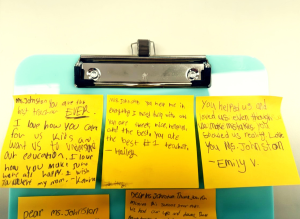
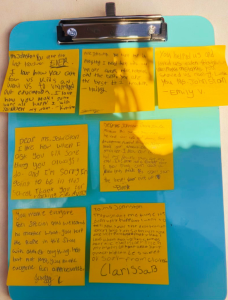
The bright yellow sticky notes cover nearly the entire clipboard.
Some are written carefully in pencil. Others stretch across the page in oversized letters—crowded thoughts and hurried excitement. A few include hearts. One says simply:
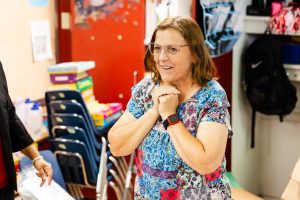
“You are the best teacher EVER.”
And then there are the notes that reveal something deeper:
“You make everyone feel special and welcomed.”
“You help everyone in this school.”
“I love how you care for us kids and want us to understand our education.”
Together, they tell the story of the kind of teacher children remember long after they leave a classroom.
That is why Janae Johnston of Worsham Elementary has been recognized by Aldine ISD as a Bright Spot in Literacy.
A Classroom Built on Thinking
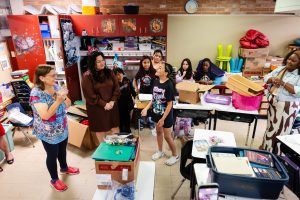 In Ms. Johnston’s classroom, literacy is active and collaborative.
Students discuss ideas, question texts, defend opinions and build on each other’s thinking in real time. Conversations move across the room with energy and purpose. Students are expected not only to read, but to think deeply about what they are reading and why it matters.
Assistant Principal Kantriece Carter said that this atmosphere is one of the defining characteristics of Ms. Johnston’s classroom.
“She creates an environment where students are not just learning literacy skills, but learning how to think critically and communicate their ideas with confidence,” Carter said.
That confidence is intentional. Students are consistently encouraged to go beyond surface-level answers, research information, make real-world connections and engage in meaningful discussions that strengthen both comprehension and critical thinking.
The Small Victories That Become Big Breakthroughs
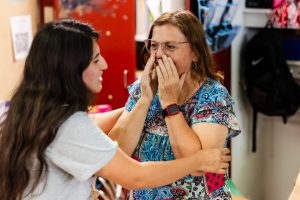 For many students, confidence in literacy does not appear all at once.
It grows through moments that may seem small from the outside: raising a hand, reading aloud or explaining an idea clearly for the first time.
Principal Pablo Siboldi remembers watching one of those moments unfold during small-group instruction.
A student was struggling through a difficult text, working carefully to decode unfamiliar words and make sense of the passage. Ms. Johnston stayed beside the student, encouraging them through the process until understanding finally clicked.
“When the student finally gets it, Ms. Johnston’s face lights up with a celebration so genuine that the student beams with pride,” Siboldi said. “She celebrates the small victories because she knows they lead to big breakthroughs.”
That approach shapes the culture of her classroom.
Mistakes are not treated with embarrassment. Students are encouraged to try, revise, question, and grow without fear of failure. Siboldi said Ms. Johnston has created what he describes as a “low-risk, high-reward learning environment” where students feel safe participating and challenging themselves academically.
High Expectations With Meaningful Support
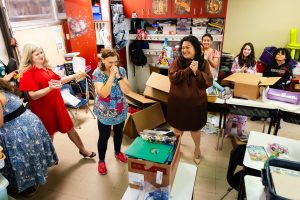
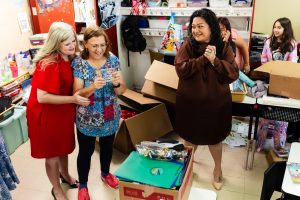
One of the things that makes Ms. Johnston’s instruction stand out is the balance she maintains between rigor and support.
Her lessons are highly differentiated, ensuring students who need additional support receive targeted instruction while advanced learners continue to be challenged. Carter noted that this is especially important in Gifted and Talented classrooms, where academic growth can sometimes be more difficult to measure because many students already perform at high levels.
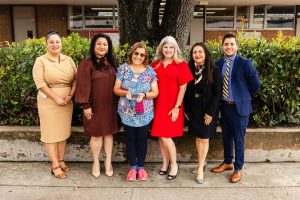 Ms. Johnston approaches that challenge intentionally.
Students track individualized growth goals based on their own data and monitor progress throughout the year. Some focus on strengthening how they explain central ideas, while others work on providing stronger evidence to support their thinking.
The process gives students ownership over their learning.
“As a result, students grow not only academically, but also in confidence and independence as learners,” Carter said.
That growth becomes visible not only in academic performance, but in the way students begin to see themselves.
“Students who once shied away from speaking up find their voices,” Siboldi said. “They develop a genuine sense of agency and a newfound identity as capable, confident readers.”
Making Literacy Feel Real
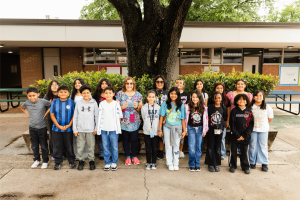
In Ms. Johnston’s classroom, reading and writing are constantly connected to life outside school.
Students discuss how literacy applies to everyday experiences, from movies and travel to friendships, conversations and decision-making. Lessons encourage students to think about how communication shapes the world around them and how their own voices matter within it.
“She consistently helps students think about how their learning applies outside of the classroom,” Carter said.
Those connections make learning feel relevant and meaningful for students, helping them engage more deeply with the work.
At the same time, Ms. Johnston brings warmth and joy into the classroom in ways students clearly remember.
Several sticky notes describe a classroom where students feel happy, encouraged and supported. One student thanked her for “making this school seem fun.” Another wrote, “You are sweet, nice, helpful and the best #1 teacher.”
A Teacher Whose Impact Extends Beyond the Classroom
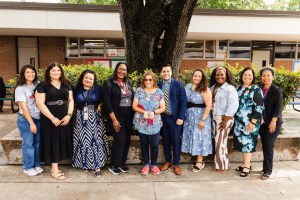 Colleagues describe Ms. Johnston as collaborative, solution-oriented and deeply committed to both students and fellow teachers.
Carter said she regularly works with her team to strengthen instruction across campus by sharing ideas, facilitating discussions and helping teachers think creatively about student engagement. Her classroom has become a model for what high-expectations literacy instruction can look like at Worsham Elementary.
Fellow teacher Ms. Woods described her as someone who still believes every student matters and who nurtures “hope, creativity, belief and authenticity” in the children she teaches each day.
That influence extends far beyond a single classroom and helps shape the culture of the campus itself.
The Story the Sticky Notes Tell
 Academic growth, instructional rigor and classroom engagement are all part of why Ms. Johnston was selected as a Bright Spot in Literacy.
But the sticky notes spread across that clipboard tell another part of the story.
They were not written for an assignment or a grade. Students wrote them because they wanted her to know how much she mattered to them.
Some thank her for making school feel fun. Others thank her for helping them when they struggled.
A few are harder to forget.
“You helped us and loved us, even though we make mistakes.”
The handwriting is uneven. Some words are misspelled. A few sentences run off the edge of the paper.
But together, the notes capture something difficult to measure through data alone: what it feels like to learn in a classroom where students feel supported, encouraged and valued.
Long after the sticky notes lose their adhesive and the school year fades into memory, the message behind them will remain.
You helped us.
You believed in us.
You never gave up on us.
And for many students, that becomes part of how they learn to believe in themselves.
About the Author: Sandra Perez Chaviano