Come Visit Us! Early Childhood to High School Campuses Hosting Open House Nights in March
Research shows that successful schools have a high percentage of parent involvement.

Ana Colindres from Carver HS is a 2016 PSAT National Hispanic Scholar. She stands next to a quote by Plato. It stresses how an education illuminates a person’s future. Parents and teachers are some of the most important influences on a child. Positive engagement impacts students’ academic performance.
[dropcap color=”#888″ type=”square”]Y[/dropcap]es, it is that time of the year again when parents visit their children’s schools. Spring open house nights help parents stay informed about children’s progress toward meeting goals.
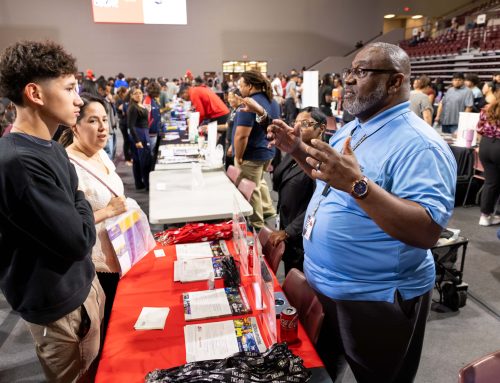
Parents across the district attended the fall open house nights. These gave parents an opportunity to get to know their children’s teachers. They offered an overview of school culture, teachers, curriculum and unique programs. During the fall open house events, teachers made parents aware of their expectations.
Spring open house nights will give parents a chance to see and hear how their children are performing in school. Teachers will discuss where students are doing well.  They will also discuss the areas parents need to focus on to help students find success in the classroom. Many schools will also display students’ work for parents to view.
Open House Nights by Level
Ninth Grade Schools/High Schools — March 1
Middle Schools — March 3
Intermediate Schools — March 8
Elementary Schools — March 9
Early Childhood/PreK Centers — March 10
(Call the schools for times.)
What Parents Can Do to Prepare
 [ul class=”list list-search”] [li]To make the most of open house night, do a little research before the event. Read any information sent home before the event.[/li] [li] At open house, there is little time for a lengthy conversation. Read [icons icon_name=”icon-external-link” icon_size=”14px”]school policies and procedures beforehand if you have questions about these. Parents can find them posted online. [/li][/ul]
[ul class=”list list-search”] [li]Review the state standards for your child’s grade level. This will give you an idea of what academics your child’s grade level is studying. If you have difficulty finding these, call the school or schedule a parent-teacher conference.[/li] [li]  View curricula before the event. These are the adopted reading materials, activities, and items used to teach students. Some may be available online to view. If not, contact the campus or your child’s teacher to schedule a time to go over the curricula. [/li][/ul]
[ul class=”list list-search”] [li]Talk to your children about their concerns. Due to limited time at open house, focus on big picture questions or general issues. Save individual student needs (i.e. academics, behavior) for a parent-teacher conference.[/li][/ul]
Topics to Discuss
 [ul class=”list list-search”] [li]Find out your child’s schedule (i.e. lunch, recess).[/li] [li] Learn how to best contact the teacher. [/li][/ul]
[ul class=”list list-search”] [li]Update your contact information.[/li] [li] Ask about volunteer opportunities at the school. [/li][/ul]
[ul class=”list list-search”] [li]Learn about classroom expectations.[/li] [li] Learn how to support your child’s learning at home.[/li][/ul]
 [ul class=”list list-search”] [li]Find out about homework expectations.[/li] [li] Ask about special upcoming events. [/li][/ul]
Campus leaders stress that parents should not confuse open house with a parent-teacher conference. At an open house, teachers will not have time to discuss your child’s specific needs. Instead write and email or send a letter in your child’s folder with your concerns. You can also call to schedule a parent-teacher conference.
 Before a parent-teacher conference, prepare questions and collect samples of your child’s work. Parent-teacher conferences should center on three major topics: the child, the classroom and the future. Remember to take notes and schedule an immediate follow-up meeting if something is unclear.
For ideas, visit the [icons icon_name=”icon-external-link” icon_size=”14px”]Harvard Family Research Project’s Tip Sheet for Parents. The site provides information on how to conduct productive, successful parent-teacher conferences.
According to Heather B. Weiss, the parent-teacher conference is no longer a once-a-year check in. They should occur as soon as parents notice a student struggling. Parent-teacher conferences can provide useful insight for immediate and clear next steps. Weiss is founder and director of the Harvard Family Research Project.
“Conferences are now a progress report,” said Weiss. “Parents should schedule these as soon as there is a concern. Time is crucial for students’ learning and progress. Parents should come out of conferences with steps they can actually do to help their children.”
Parents can also try to connect with the school guidance counselor. He or she can provide information about resources the school offers. This could include gifted testing as well as resources outside of school. Call the campus to find the correct personnel.
Superintendent of Schools Dr. Wanda Bamberg encourages parents to attend open house nights and schedule parent-teacher conferences. Parents should communicate regularly with teachers as well as be involved in their children’s education and interest areas.
“The [icons icon_name=”icon-external-link” icon_size=”14px”]research shows that family engagement is key to student success,” said Bamberg. “Parent engagement is associated with higher grades, higher test scores and better attendance. The result is higher motivation and an increase in students pursuing post-secondary education.
“We want both the teacher and the parent to have a positive experience. When parents and teachers work together, students make greater gains. And that is something we all want for our children.“
Be Involved In Your Child’s Education. Help Your Child Succeed in School.
About the Author: Leticia Fehling