Disponible en:
 Español
District’s New Advisory Council for Advanced Academics to Begin Process to Strengthen, Expand Program
Disponible en:
Español
Aldine seeks to increase inclusivity, enhance rigor, and create more opportunities for students.

The Advanced Academics Advisory Council will begin the process to strengthen and expand the program with initial meetings, known as Design Days, set for July 14 and July 15, with the second session taking place on July 21 and July 22.
Susan Pelezo, executive director of advanced academics, is leading the Council. The Council is a collaboration between district leaders and a diverse group of community stakeholders dedicated to strengthening the Advanced Academics program in Aldine ISD. Members will develop a framework to meet several Aldine ISD strategic plan, A New Way Forward, priorities which include student achievement and expanding options to college and career access.
What exactly falls under Advanced Academics?
Advanced Academics is an umbrella term that encompasses all the differentiated programs and services the Aldine Independent School District offers to its advanced and high potential learners. These programs and services are specially designed to extend, enrich, and accelerate the standard school program to meet students’ (K-12) needs.

Programs and services include gifted and talented (GT), advanced-level classes at the middle and high school levels, Duke TIP (Duke University’s Talent Identification Program); advanced placement classes, as well as dual credit courses, and dual enrollment in University of Texas (UT) OnRamps program at the high school level; subject- or grade-level acceleration at all levels, and college and career readiness (e.g., PSAT, SAT, ACT).
Aldine ISD is expanding its UT OnRamps program from two courses in the 2019-2020 school year to 10 courses in 2020-2021.
The goal is to broaden identified students’ knowledge, skills, and experiences beyond their traditional classroom setting. The program emphasizes developing independent, self-directed learners by encouraging and supporting in-depth learning, critical thinking as well as divergent and creative thinking.
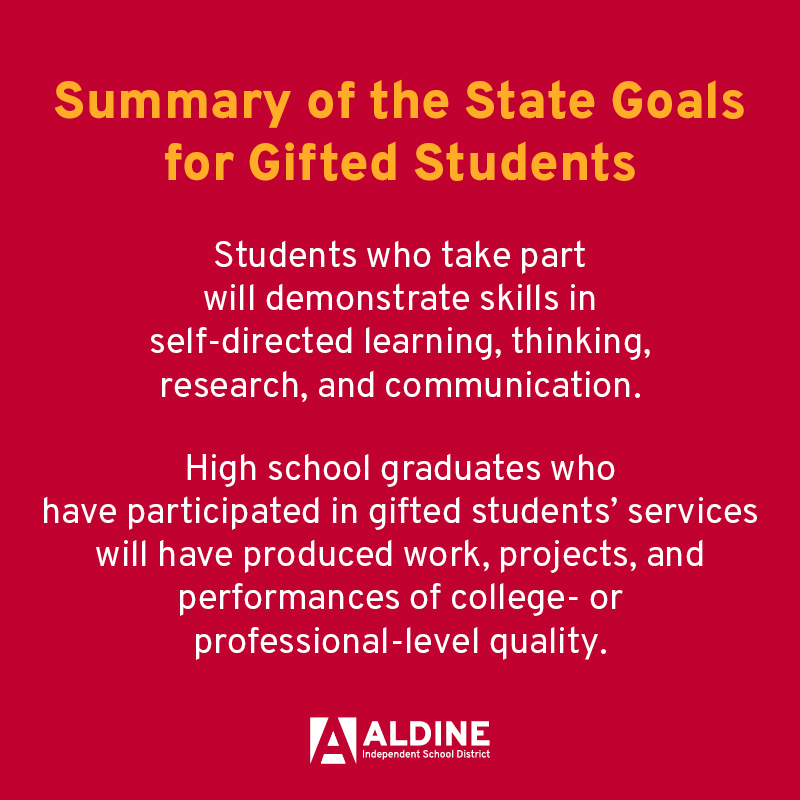 The Advanced Academics Program advocates for appropriate academic challenges for all students. It also strives to efficiently educate and support the district, campuses, and parents.
The Texas State Plan for The Education of Gifted/Talented Students requires an Advisory Council for Advanced Academics for every school district that offers these programs and services.
What is the role of the Advisory Council for Advanced Academics?
The Council reviews the district’s advanced academics plan, including revisions. It also determines the extent to which it was implemented for the previous year.
Members of a Council explore successful practices, strategies, and curriculum in K-12 in schools that offer Advanced Academics. The Council proposes a set of school-based actions to increase access to challenging learning experiences at all levels.
Who comprises the Council?
 The Council includes parent representatives of students that have been identified as gifted and talented, the executive director of advanced academics, campus administrators, school counselors, GT coordinators, teachers, including Teaching and Learning Program directors representing every K-12 level. The Council addresses the students’ needs in the Advanced Academics program. The AISD inaugural Council plans to meet at least three times during the school year.
Pelezo added that the mission of the Advanced Academics Advisory Council is to enhance the bridge between families and Aldine ISD educators by engaging in the school community through communication to families and honoring the perspectives of families and educators.
“To strengthen our Advanced Academics K-12 Program, we need to hear all perspectives,” Pelezo said. “I want to connect diverse voices to inspire action and impact students’ opportunities, experiences, and successes.”
During Design Days, members of the Advanced Academics Advisory Council will work with a consulting firm in the design thinking process on creating an advanced academics framework, which will advocate for the expansion and inclusivity of GT and Advanced Academics programs.
Email Dr. Susan Pelezo at [email protected] for more information about Aldine’s Advanced Academics Programs.

Children are classified as gifted if they demonstrate exceptional levels of aptitude or competence. These levels can be in one or more areas of academic activity such as mathematics, music, language, etc., or a set of sensorimotor skills such as dance, athletics, art, etc.
A child’s giftedness can be evident in those who perform exceptionally well on academic skills or performance-based tests or assessments.
They can also show the ability to learn and assimilate information more rapidly than other children their age, experience, and environment.
As gifted children grow and develop, their giftedness is characterized by high levels of achievement, motivation, individuality, and creativity.
About the Author: Leticia Fehling