Disponible en:
 Español
District to Go Red on Friday, October 4 for World Dyslexia Day
Disponible en:
Español

World Dyslexia Day, October 8, raises awareness of this learning difficulty and celebrates the unique experiences of the dyslexic community. It challenges common misconceptions and showcases the diversity within the community. By understanding and appreciating these unique experiences, we can ensure that every student with dyslexia receives the early identification and intervention they need to flourish.
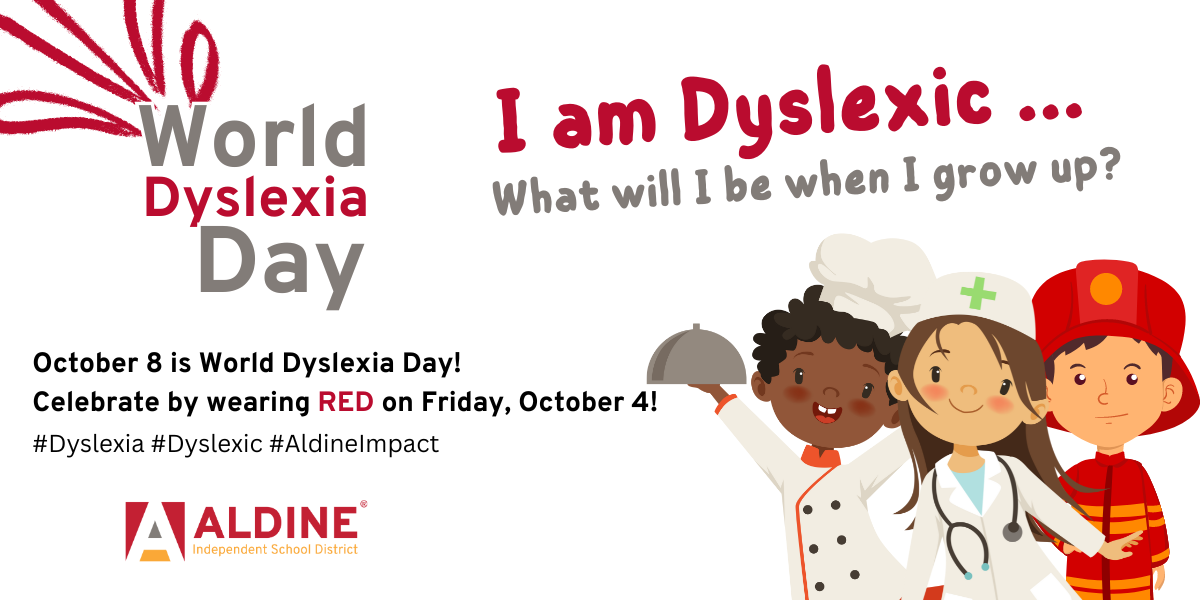 Go RED on October 4! Celebrate Learning Diversity
Since World Dyslexia Day falls during the district’s fall break (Tuesday, October 8), everyone is encouraged to wear RED on Friday, October 4! Be sure to share your images on social media with the hashtags #AldineImpact, #Dyslexia, and #Dyslexic.
About Dyslexia
Dyslexia is very common, affecting 20% of the population and 80% to 90% of all those with learning disabilities—about 1 in 5 people. Most students have dyslexia, but most don’t know they have it. Dyslexia can’t be “cured”—it is lifelong. However, with the proper support, dyslexic individuals can become highly successful students and adults.
Early identification of dyslexia is crucial. This language processing disorder can hinder reading, writing, spelling, and speaking, and it might manifest differently for speakers of different languages. However, if identified early, students can excel. This underscores the urgency and significance of early identification in ensuring student success.
5 Clues to Recognizing Dyslexia
-
- Difficulty Rhyming
- Consistently Inconsistent Reading
- Writing and Spelling Are Hard
- Struggles With Word Retrieval
- Challenges Memorizing Information
Strengths of Individuals With Dyslexia
Creative • Intuitive • Empathetic • Critical Thinkers • Big Picture Thinkers • Strong Reasoning Skills • Excellent Problem-Solvers • Excellent Oral Comprehension
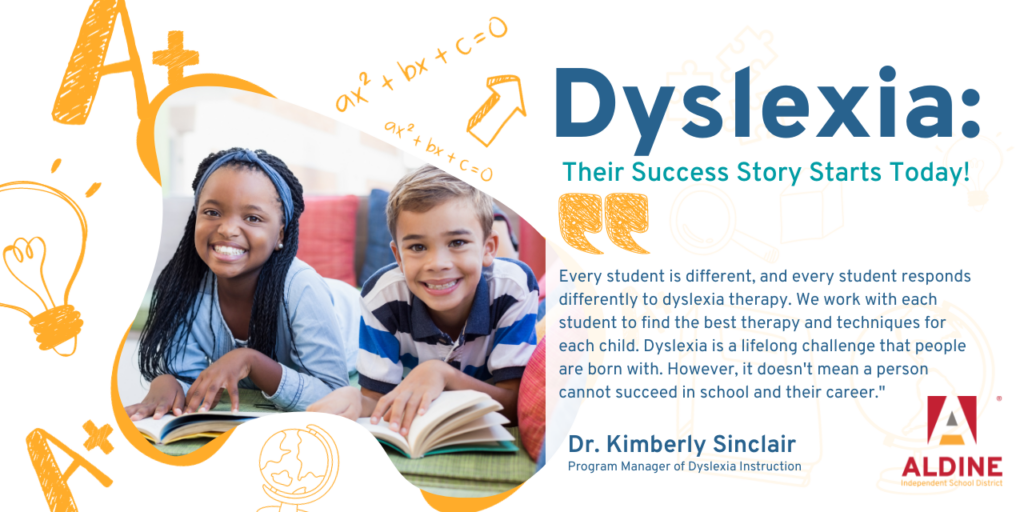 Dr. Kimberly Sinclair, program manager of dyslexia instruction, stated that her office and schools can share tools that aid dyslexic students at home and in school. They can learn about the following:
- Support
- Accommodations
- Technology
- Emergent bilingual learners
- Library resources
- Visual stress/Irlen syndrome
Aldine ISD and its campuses have a great program to support students with dyslexia. Every student is different and responds differently to dyslexia therapy. Sinclair added that staff members work with each student to find the techniques that work for them.
“Dyslexia is a complex, lifelong learning disorder,” said Sinclair. “It can be frustrating for parents to know how best to support their child with dyslexia. Schools are responsible for ensuring children learn to read and write and access the curriculum to maximize their potential. However, parents have an important role too. The best outcomes result when parents, teachers, and specialists coordinate support for students with dyslexia.”
Some Pretty Famous People With Dyslexia — You CAN Be Anything!
Some famous people with dyslexia or who had dyslexia include Albert Einstein, Thomas Edison, Leonardo da Vinci, Walt Disney, Tom Cruise, Johnny Depp, Keira Knightly, Whoopi Goldberg, Jamie Oliver, Tommy Hilfiger, Pablo Picasso, Andy Warhol, Muhammad Ali, Steve Jobs, Charles Schwab, William Hewlett, Steven Spielberg, Ludwig van Beethoven, Wolfgang Amadeus Mozart, Winston Churchill, Benjamin Franklin, Thomas Jefferson, Nelson Rockefeller, John Irving, Agatha Christie, Edgar Allan Poe, George Washington, W.B. Yeats, Richard Branson, Stephen Hawking, Ann Bancroft, Octavia Spencer, Abraham Lincoln, John F. Kennedy, Daymond Garfield, Nolan, Ryan, Magic Johnson, Salma Hayek, and John Lennon.
Questions About Dyxlexia
Visit the Dyslexia Department webpage if you have any questions about dyslexia.
Dyslexia-friendly Books
- The Griffin Gate Series
- Book Riot List
- The Yale Center for Dyslexia & Creativity: Young People’s Books About Dyslexia
- Teaching Expertise: 23 Incredible Kids’ Books About Dyslexia
- Brightly: 9 Children’s Books About Dyslexia
About the Author: Leticia Fehling