Disponible en:
 Español
Aldine Releases Child Nutrition Services Protocols for Return to Learn
Disponible en:
Español

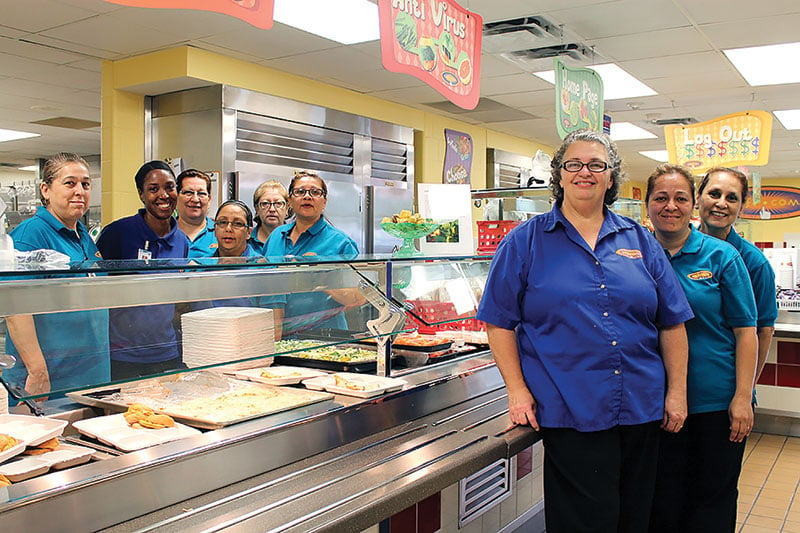
The first priority of Child Nutrition is to ensure the health, safety, and well-being of our students. Through continued guidance from the State of Texas, the Texas Education Agency, and local health authorities, our Return to School guidelines will be used to focus on and communicate methods to all stakeholders.
Child Nutrition Protocols
- Aldine ISD Child Nutrition staff are screened daily with temperature scanning. Any employee with COVID symptoms or exposure may not report to work.
- Aldine ISD Child Nutrition staff will use face shields, facial coverings, and gloves when performing job responsibilities and are trained to practice health and hygiene regulations.
- Aldine ISD kitchens and cafeterias are cleaned and disinfected daily.
- Aldine ISD cafeterias, serving, and eating areas are cleaned between uses.
- Grab N Go carts are utilized as needed at designated campuses to minimize cafeteria lines, increase the speed of service and enhance social distancing
- Signage is located in cafeterias to reinforce social distancing.
Meal Service
- Breakfast and lunch will be provided for all students learning at home or learning at school.
- Students learning at home will be provided with meals through curbside service. Designated school sites, days, and times for available pickup will be communicated on the district and Child Nutrition websites.
- Students learning at school in grades 1 through 12 will be provided meal service through a number of methods:
- Mobile Breakfast carts will be stationed throughout each school to practice social distancing and speed service.
- Limited dining room seating for a number of students that may dine in the cafeteria at specific tables marked to ensure social distancing.
- Students will enter the cafeteria using social distancing floor markers, make lunch selections, and then travel back to the classroom with closed containers.
- Primary School students will have meals delivered to the classroom and/or utilize limited dining room seating.
- Students must provide an ID at breakfast and lunch to ensure efficient scanning of ID for payment and minimize touching of ID by multiple staff.
- Students must follow social distancing signage displayed.
- Students may be directed to eat in various locations throughout the building, including classrooms, to maximize social distancing.
Meal Payments
- Parents are encouraged to use www.SchoolCafe.com for prepayments to provide student meal money instead of sending cash to your child’s campus.
- Breakfast is offered at no cost to all students; lunch costs $2.25 for secondary schools and $2.00 for elementary levels.
- Learning at Home, students will have curbside meals available for the same prices as meals served in the school.
- Your child(ren) may qualify for free meals or reduced-price meals. The reduced price is $0.40 for lunch. Please visit www.SchoolCafe.com to apply for free or reduced-price meal benefits.
- Students without money for lunch will be allowed to purchase full meals up to a $20 debt limit. Purchase of a la carte items will not be allowed if a student has a negative balance.
- Parents are strongly encouraged to monitor their student’s meal account balance.
- Payments may be made in the school cafeteria or online at SchoolCafe. Please visit www.SchoolCafe.com to register. SchoolCafe allows parents to apply for free or reduced-price meal benefits, monitor account balances, or check menus.
Non-Discrimination Statement: This explains what to do if you believe you have been treated unfairly: The U.S Department of Agriculture prohibits discrimination against its customers, employees, and applicants for employment on the basis of race, color, national origin, age, disability, sex, gender identity, religion, reprisal, and where applicable, political beliefs, marital status, familial or parental status, sexual orientation, or all or part of an individual’s income is derived from any public assistance program, or protected genetic information in employment or in any program or activity conducted or funded by the Department. (Not all prohibited bases will apply to all programs and/or employment activities.) If you wish to file a Civil Rights program complaint of discrimination, complete the USDA Program Discrimination Complaint Form, found online at http://www.ascr.usda.gov/complaint_filing_cust.html, or any USDA office, or call (866) 632-9992 to request the form. You may also write a letter containing all of the information requested in the form. Send your completed complaint form or letter to us by mail at U.S. Department of Agriculture, Director, Office of Adjudication, 1400 Independence Avenue, S.W., Washington, D.C. 20250-9410, by fax (202) 690-7442 or email at [email protected]. Individuals who are deaf, hard of hearing or have speech disabilities may contact USDA through the Federal Relay Service at (800) 877-8339; or (800) 845-6136 (Spanish). This institution is an equal opportunity provider.
About the Author: Leticia Fehling

Director of Internal Communications